Wednesday, May 6, 2009

StoryCraft Ages 6-9

While storytelling is a great favorite of preschoolers, many elementary age children are more drawn to crafts and other activities. StoryCraft is an award-winning library program that combines storytelling with crafts in an exciting and engaging activity for children in first through third grades. Each one-hour program includes storytelling, a craft, movement, activities, music, and discussion. This collection of StoryCraft programs presents 50 fun and educational theme-based sessions. Each includes suggestions for promotion, music, crafts, activities, and stories. The sessions also include bibliographies to help direct young readers toward additional reading, as well as diagrams, detailed instructions, and supply lists for the crafts. The themes range from a Jungle Safari to Math Mayhem to a Western Roundup, all encouraging children to enjoy reading in a variety of ways. Each session has plenty of suggestions, so that the program can be customized. Helpful Hints for implementing the program can help any librarian, volunteer, or parent turn a ho-hum storytime into a dazzling StoryCraft time.
Storycraft: 50 theme-based programs combining storytelling, activities and crafts for children in grades 1-3, Ages 6, 7, 8, 9
By Martha Seif Simpson, Lynne Perrigo
Illustrated by Lynne Perrigo
Edition: illustrated
Published by McFarland & Co., 2001
Original from the University of Michigan
Digitized Oct 30, 2008
ISBN 078640891X, 9780786408917
283 pages
A collection of popular, child-tested ...
... programs. Themes include dragons, cowboys and cowgirls, kites, and magic, and are arranged alphabetically by title of program not content ("What's Cooking?" is last rather than under "food"). Each unit includes suggestions for a bulletin board, background music, an opener, stories, a group-participation activity, a craft, and numerous titles to booktalk. Step-by-step instructions for presenting the programs are offered, from promotion to cleanup, as well as "Helpful Hints." Craft instructions are divided into two parts-preparations to be done ahead of time and what the children do during the program. The authors warn that these programs are labor intensive and suggest two librarians in addition to utilizing volunteers. However, many ideas could be simplified, though the authors do not provide suggestions for doing so. A must for public librarians looking for programs to keep kids coming to the library after they've graduated from storytime.-Shauna Yusko, King County Library System, Bellevue, WA

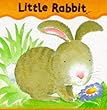
Little Rabbit Ages Birth to 5

Little Rabbit
By Nicola Smee
Edition: illustrated
Published by Little Orchard, 1999
ISBN 1860397867, 9781860397868
8 pages Board Book
Ages 1, 2, 3, 4, 5

The Great Carnival Caper Ages 8-10

The Great Carnival Caper
By John Speirs
Edition: illustrated
Published by Reader's Digest Kids, 1993
ISBN 0895774534, 9780895774538
32 pages
From School Library Journal
Grade 2-4, Ages 8, 9, 10 -A mind-stretching, innovative picture book, reminiscent of the popular "Waldo" books (Little), only on a more complex level. Three children try to find out why the Thirteen Clown Carnival is in chaos. Someone keeps mixing up the rides and causing trouble. Readers solve the mystery by cracking hidden codes, searching through mazes, and solving puzzles. Visual challenges abound, such as finding 25 things wrong with the carnival in one picture, or locating the sideshow performers in a crowd. The detailed, colorful watercolors will keep children puzzling over this book for a long time. Answers are included in the back.
Janet M. Bair, Trumbull Library, CT
Copyright 1994 Reed Business Information, Inc.

Product Description
A series of picture puzzles in which the reader helps three young Puzzle Masters and their dog locate carnival entertainers, animals, and other attractions, decode messages, and find the villain responsible for wreaking havoc with the carnival.

Whale Ages 9-12

Describes whales, dolphins, seals, and other marine mammals, their habitats, means of communication, and family life.
Whale
By Vassili Papastavrou, Frank Greenaway
Illustrated by Frank Greenaway
Edition: illustrated
Published by Dk Pub, 2000
ISBN 0789465957, 9780789465955
64 pages Ages 9, 10, 11, 12
From School Library Journal
Grade 3-6-Although indexed and divided into chapters, this introduction to whales is more an attractive browsing item than a substantive work of nonfiction. The two-page entries cover such topics as evolution, physical characteristics, social life, reproduction, and more; headings such as "I am the Walrus" attempt to introduce a hint of humor into the text. Every page is laced with full-color photographs and drawings of marine mammals in a collage type arrangement, and every now and then a small cartoon or "funny bit" is inserted. The writing is often vague and imprecise, e.g., in the evolution entry, "sea otters entered the oceans relatively recently" is stated to explain their still-furry appearance and dependence upon land, but what does the author mean by relatively recently-last week? On the other hand, the brief explanation of the Greek terms for whales' fins-the pectoral (chest) and the dorsal (back)-is well done. Not for reports, but acceptable recreational reading.
Frances E. Millhouser, Reston Regional Library, VA
Copyright 1993 Reed Business Information, Inc. --This text refers to an out of print or unavailable edition of this title.

Review
...a mini museum between the covers of a book. [Eyewitness series] -- The New York Times

These books' striking visual impact will draw in even the most casual readers. [Eyewitness series] -- School Library Journal

Saturday, May 2, 2009

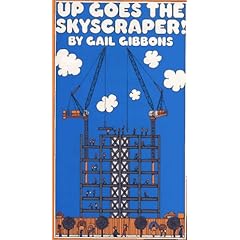
Up Goes the Skyscraper Ages 4-9

Follows, in simple text and illustrations, the building of a skyscraper step by step.
Up Goes the Skyscraper!
Illustrated by Gail Gibbons
Edition: illustrated
Published by Four Winds Press, 1986
ISBN 0027367800, 9780027367805
32 pages
Gibbons' specialty is non-fiction ...
... picture books with brilliant colors, bold design, and subjects of special interest to her audience. Like dinosaurs, skyscrapers hold perpetual fascination; here's a step-by-step description of their construction. Beginning with the space demands that lead to the need for such a building, Gibbons covers design, the stages of construction from foundation to crowning the top with an evergreen for good luck and finishing the interior. The reader becomes a sidewalk superintendent with a prime view as the tower cranes mount this appropriately tall, slim book. The brief narrative, copious captions, and, best, the clear pictures unite to make a highly informative book on a popular subject.
Kirkus Reviews Copyright (c) VNU Business Media, Inc.
From Publishers Weekly
Jones has outdone herself in this frolicking, warmhearted fantasy. Convinced she's a failure, Sophie Hatter is resigned to working in her stepmother's hat shop. Then the evil Witch of the Waste appears, turning Sophie into an old woman. For the first time, Sophie must take charge of her own life. But she also must free herself from the Witch's spelland the only one who can help her is the Wizard Howl, whose moving castle is terrifying the countryside and who is rumored to suck the souls of young girls. Everything is part of a vast jigsaw puzzle, and no one and nothing is as it seems. There are spells and counterspells, battles, fire demons, possessed scarecrows, lost loves, and intertwining worlds, and it's all great fun. Thoroughly enjoyable, a wonderful blend of humor, magic and romance.
Copyright 1986 Reed Business Information, Inc.
From School Library Journal
Kindergarten-Grade 3 Ages 4, 5, 6, 7, 8, 9 Gibbons' usual work is still very unusual and, as usual, she has done a magnificent job of explaining a complex subject. Without oversimplification, she traces in straightforward text and brightly colored pictures the construction of a skyscraper from the clearing of the site to tenant move-in. Younger children will find answers to many questions, including why an evergreen tree is placed on top of a new building. Older children will appreciate the additional details and definitions incorporated into the illustrations. Male and female, multi-ethnic workers are included for a variety of trades and professions. Nothing similar is available for this age group; Sandak's Skyscrapers (Watts, 1984) is broader in scope and slightly higher in reading level. Like a skyscraper, Up Goes the Skyscraper! packs a lot into a small amount of space. Jeanette Larson, Mesquite Public Library, Tex.
Copyright 1986 Reed Business Information, Inc.

This is New York Ages 4-8

PREVIEW 2003 EDITION
My Book is the First Edition, Hardback
A pictorial tour of Manhattan Island presenting drawings of its neighborhoods, transportation and traffic, buildings, and the city's activities, from the local shoeshine stall to Wall Street.
This is New York
By Miroslav Sasek
Published by Macmillan, 1960
60 pages Ages 4, 5, 6, 7, 8
Hardcover
Publisher: New York Macmillan c; First Edition edition (January 1, 1960)
ASIN:
B000NZ5CL4
Product Dimensions:
12.2 x 8.9 x 0.7 inches
http://web.archive.org/web/20061031043633/http://www.miroslavsasek.com/reviews/ny_rozzo.html
http://web.archive.org/web/20061031043355/www.miroslavsasek.com/reviews/newyork.html

The Houdini Box Ages 6-11

A chance encounter with Harry Houdini leaves a small boy in possession of a mysterious box--one that might hold the secrets to the greatest magic tricks ever performed.
The Houdini Box
By Brian Selznick
Illustrated by Brian Selznick
Edition: illustrated
Published by Random House Children's Books, 1991
ISBN 0679814299, 9780679814290
56 pages
A fervent admirer of Houdini, ten-year ......-old Victor tries to emulate his feats, but to no avail: getting out of locked trunks and holding his breath for 5000 seconds are beyond his powers. Spying Houdini himself in a railroad station, he begs for his secrets and is promised a letter. Eventually, it arrives: "A thousand secrets await you. Come to my house...." But it's the day of Houdini's death; the grieving widow hands Victor a locked box with the initials E.W. Unable to open the box, and concluding that it couldn't have belonged to the great magician anyway, Victor forgets it until years later when, playing baseball with his son Harry, the ball happens to land on Houdini's grave and he learns his original name: Ehrich Weiss. And that night, Victor at last succeeds in escaping from his grandmother's trunk. Selznick illustrates his first book with vigorous, carefully composed b&w drawings; his faces express emotion with subtlety and quiet humor. The offbeat story is smoothly told; whether children will be pleased by the understated denouement with its ghostly overtones remains to be seen. In any case, it's an interesting debut, handsomely produced. A historical note is appended.
Kirkus Reviews Copyright (c) VNU Business Media, Inc.
From Publishers Weekly
In his first book for children, Selznick presents the compelling story of Harry Houdini, the magician who amazed the world with his great escapes. While Houdini circles the globe performing one incredible stunt after another, Victor, a young devotee, goes through his own rigorous magician's training at home--locking himself in closets, holding his breath under water, walking into walls. This counterpoint is a witty, effective device, and Selznick's deadpan text makes the most of it. It seems that Victor will never become a magician, until one day, after a chance encounter with his hero, he receives a special box that just might contain the secrets of Houdini's success. In his arresting, informative blend of fact and fiction, Selznick splendidly captures the sense of wonder that surrounded Houdini. Equally impressive are his evocative drawings; by turns droll, touching and downright silly, they bring added vitality to a captivating book. More than anything, however, this ambitious work teaches the importance of faith and the ability to believe in the impossible. Ages 6-11.
Copyright 1991 Reed Business Information, Inc.
From School Library Journal
Grade 2-5, Ages 7, 8, 9, 10, 11-- Ten-year-old Victor has no success emulating his hero, Harry Houdini; no matter how hard or often he tries, he just can't escape from a locked trunk, or hold his breath underwater for 5000 seconds, or run through walls. Then he meets the magician himself in a crowded train station, and some time later receives a mysterious locked box engraved with the initials "E. W." Victor can't imagine who E. W. is and, disappointed, puts the box away. Years later, after Victor grows up and has a son of his own, he learns that Houdini's real name was Ehrich Weiss; he rushes home, opens the box, and that night, while his wife and child lie asleep, he locks himself in the trunk--and escapes in less than 20 seconds. Crosshatched pencil drawings expertly capture the story's droller moments, as well as Victor's changing expressions; details of dress and furnishings, plus dramatic posters on the endpapers, give this a period look and, appropriately, a slightly sentimental flavor. A capsule biography of Houdini is appended. This brief story has an appeal beyond its reading level. --John Peters, New York Public Library
Copyright 1991 Reed Business Information, Inc.